6 min

Reason 1: Deal intake creates unnecessary manual work
Reason 2: Document review becomes a bottleneck
Reason 3: Risk signals are scattered across systems
4 signs your underwriting process is slowing you down
The fix: AI-powered underwriting
From application to decision in minutes
6 min
Manual underwriting often seems more cost-effective, especially for funders that already have a skilled team and a set process. Adding automation entails additional software costs and time to integrate it into existing workflows.
But as deal volume increases, more submissions create more manual data entry and document review. This eventually stretches your team’s capacity. So the real question is whether manual underwriting remains cost-effective in long term as your business scales, rather than looking at the status quo.
What Is Manual Underwriting in RBF
Manual underwriting is the process of evaluating a business's financial condition, repayment capacity, and overall risk through the human approach.
In the process, the underwriter(s) review the documents and run calculations to determine whether a deal should move forward. Many funders still use manual underwriting for good reasons. Skilled underwriters can spot details that don’t fit into a simple rule or score. For businesses with fewer deals, manual work can also be manageable.
How Manual Underwriting Works
A typical underwriting process moves through these stages:
- Application review: Verify business identity, ownership, time in business, and registration records
- Bank analysis: Pull 3-6 months of statements, calculate average daily balance, identify NSFs, map existing positions, and assess cash flow consistency
- Background check: Review UCC filings, judgments, tax liens, and run negative news searches on the business and owner
- Risk assessment: Evaluate industry risk, repayment capacity, and macroeconomic conditions before structuring the offer
Each step is important and can be time-consuming. Underwriters must cross-check documents and sources to ensure sound decisions. Refer to The Complete RBF Underwriting Guide for further information.
The Cost of Manual Underwriting
When more applications start rolling into your inbox, that's a good sign your business is growing. But that also increases operational costs as you need to expand your underwriting team to keep up.
In addition, relying entirely on manual underwriting can create other costs over the long term:
- Unqualified deals: It’s common for > 50% of deals to never get funded due to excessive stacking, poor credit, etc. Time spent on unqualified deals could be better allocated to deals worth funding.
- Slower turnaround: Speed is a competitive advantage. ISOs often submit one deal to multiple funders at once. So a two-hour underwriting process can easily lose the funding opportunity to a competitor who sends an offer faster.
- Human error: Manual data entry and document review leave room for mistakes. A missed NSF, positions, or incorrect revenue calculation can change the profile of a deal. Also, human judgment can be subjective and prone to bias, which means underwriting decisions may vary from one underwriter to another.
- Scaling: If each increase in submissions requires additional processing capacity, expanding the team becomes a requisite to grow the business.
In simple terms, manual underwriting comes with significant opportunity costs. When an underwriter spends two hours on manual paperwork, that’s two hours they could have used on better-qualified opportunities or more challenging files where their experience really counts.
This opportunity cost increases as your business scales. For example, processing four deals per day totals 80 deals per month. Saving 15 minutes on each deal would free 20 hours monthly - the time it would take to underwrite 10 more deals. As submissions rise, the lost time from manual processes adds up quickly.
Concerns with Overseas Processors
Some funders cut costs by outsourcing document processing overseas. The savings might look attractive at first, but there are trade-offs. Sharing sensitive information such as bank statements, EINs, and SSNs with overseas teams can pose privacy and compliance risks. Different time zones and uneven quality of work can also diminish the benefits.
Automated Underwriting
Automated underwriting isn't new. Early systems, such as Fannie Mae's Desktop Underwriter from the 1990s, used predefined rules and logic to review financial and credit information. The system follows criteria programmed by humans. For example:
IF credit score > 620
AND debt-to-income ratio < 43%
AND loan-to-value ratio < 80%
THEN approve
The system would extract these numbers from documents and apply the rules to accept or reject applications. This was faster than manual review but had limitations.
Today's AI-powered underwriting is more advanced. Going beyond following preset rules, these tools can recognize patterns, spot anomalies, and analyze information across submitted documents and external data sources. They then provide a risk assessment along with supporting rationale.
Manual vs. Automated Underwriting
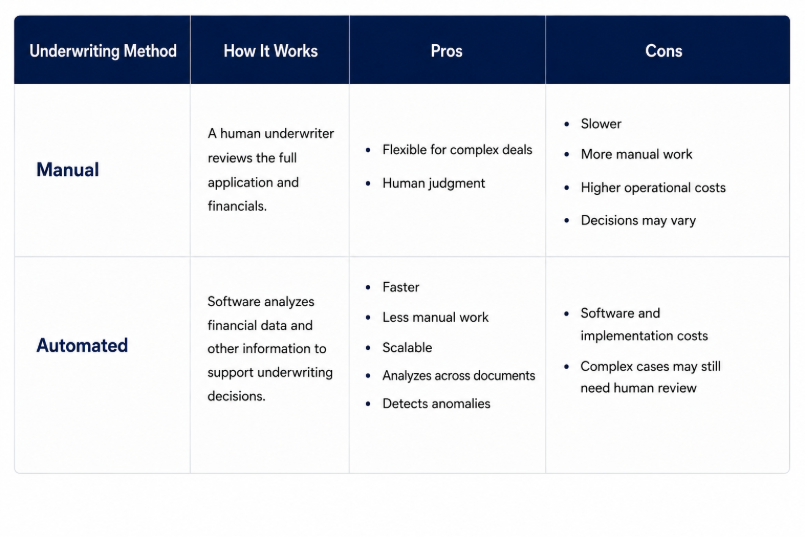
When shifting from manual to automated underwriting approach, there’re some common concerns. Is AI-powered automation fully reliable? A practical approach is a hybrid model that combines automated checks with a final human review. Human decision-making is still important, particularly for complex deals and situations that don't fit standard criteria. With automation handling more repetitive work, underwriters can spend more time reviewing these cases and making final decisions.
Another common concern that makes lenders hesitant is the implementation cost. A new underwriting system comes with licensing costs and takes time to integrate into an existing workflow. They also need training before they are fully comfortable using it. However, the cost should be evaluated against the long-run operational cost of staying manual. As deal volume increases, hiring additional staff can become far more expensive than investing in software.
How Dragin Helps
Dragin's AI-powered underwriting tools are built specifically for RBF and alternative finance operations, automating the entire underwriting process to support funding decisions.
- Bank Scrubber analyzes bank statements in seconds, calculating revenue, identifying NSFs and existing positions, and categorizing transactions.
- Auto-Decliner screens out unqualified deals based on your criteria to save you time and costs, with specific decline reasons provided for each decision.
- AI Risk Report brings financial behavior, business records, legal hist aq q1ory, and public data together to provide a more complete picture of risk.
- Zeus works as an AI underwriting assistant, reviewing key metrics and answering questions in real time as your team works through a deal.
Ready to see how Dragin fits into your underwriting workflow? Book a demo
Related articles





Every deal.
One Platform.
The all-in-one platform that helps you process deals faster with less manual work and more confidence.